
If you have ever looked inside a ring or at the clasp of a necklace, you may have noticed tiny jewelry stamps made up of numbers or letters. Most people recognize 10K, 14K, or 18K, but what about 585, 750, 925, 999, GF, or GP?
Jewelry stamps, sometimes called hallmarks or metal markings, can tell you quite a bit about what a piece is made of. The trick is knowing how to read them.
What Do Jewelry Stamps Like 585 and 750 Mean?
Gold jewelry is not always marked with the familiar karat system. Some pieces use a three-digit number to represent the metal’s purity.
For example, 585 means the metal is approximately 58.5 percent pure gold, which corresponds to 14K gold. A 750 stamp means approximately 75 percent pure gold, or 18K. That is why you may occasionally see both 18K and 750 stamped on the same piece.
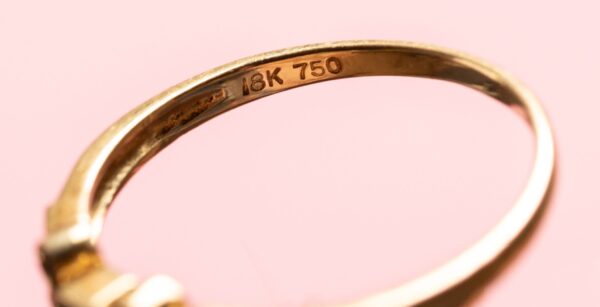
Some common markings include:
| Stamp | What It Commonly Means |
|---|---|
| 416 or 417 | 10K gold |
| 585 | 14K gold |
| 750 | 18K gold |
| 916 | 22K gold |
| 925 | Sterling silver |
| 999 | Fine silver or high-purity gold, depending on the item |
So if you inherited a necklace marked 585, it may simply be another way of identifying 14K gold.
What Does 925 Mean?
A 925 stamp generally means sterling silver, which contains 92.5 percent silver.
Sometimes a piece marked 925 may appear gold colored. That does not necessarily mean it is solid gold. Sterling silver can be covered with a layer of gold, including jewelry that may qualify as vermeil.
Color alone does not always tell you what a piece of jewelry is made of.
What Do GF and GP Mean?
The letters beside a gold marking can be just as important as the number.
GF means gold-filled. Gold-filled jewelry has a layer of gold bonded to another metal. It contains more gold than typical gold-plated jewelry, but it is not the same as solid gold jewelry.
GP means gold-plated. Gold-plated jewelry has a thinner layer of gold applied over another metal.
You may also encounter markings such as RGP, meaning rolled gold plate, or HGE, meaning heavy gold electroplate, particularly on older jewelry.
This is why it is important to read the entire stamp. A piece marked 14K GF, for example, is not the same as a piece simply marked 14K.
What If the Stamp Is Missing or Hard to Read?
Jewelry markings can become faint after years of wear. A ring may have been resized, an older piece may use an unfamiliar mark, or a stamp may simply be difficult to see without magnification.
Don’t dismiss a piece with no visible stamp automatically. The absence of a marking does not necessarily mean a piece has no value, just as the presence of a stamp does not always prove exactly what the metal contains.
When there is a question, the jewelry can be examined and tested.
Does the Stamp Tell You What Your Jewelry Is Worth?
Not by itself.
The metal and its purity are important, but value can also depend on the weight, diamonds or gemstones, condition, maker, craftsmanship, and collectibility of a piece. Precious metal prices also change over time.
A tiny stamp can be a helpful starting point, but it does not tell the whole story.
Have Jewelry You Are Curious About?
Inherited jewelry is often where these markings become especially interesting. A family jewelry box may contain pieces collected over several generations, including broken chains, single earrings, old rings, or pieces with unfamiliar stamps.
If you have jewelry you are curious about, bring it to David’s Jewelry & Coin Exchange in College Station, serving Bryan, College Station, and the Brazos Valley. We can examine the piece, help you understand the markings and, if needed, test the metal.
If you are interested in selling, David’s Jewelry & Coin Exchange buys gold and sterling silver jewelry, including broken and unwanted pieces, as well as diamonds, watches, coins, bullion, and sterling silver items.
If you are looking to buy, stop in and browse our selection of estate and pre-owned jewelry, including gold and silver pieces in a variety of styles and price ranges.
The next time you notice a tiny number inside a ring or on a necklace clasp, take another look. That little stamp may tell you more than you think.